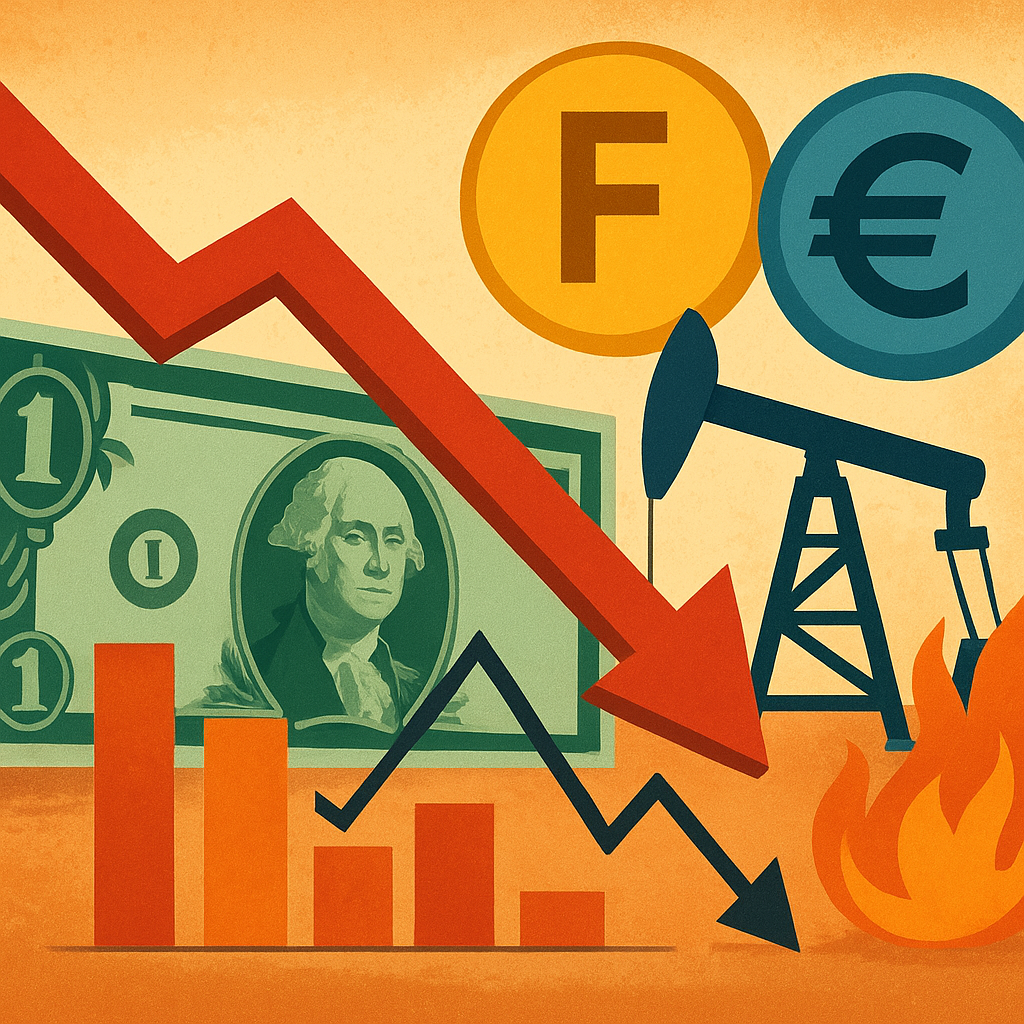
Dollar Dims as U.S. Inflation Decelerates; Forex Markets Brace for Fed and ECB Policy Path Amid Middle East Energy Shocks
The foreign exchange market faced a low-volatility lull in the first half of July, then pivoted on a string of fresh data and policy signals that traders weighed against renewed geopolitical risks. The biggest takeaway for currency traders was not a single surprise outcome, but a synchronized reassessment of rate expectations in the United States and Europe as inflation trends and energy prices remained in focus. This week’s flow points to a bifurcated risk environment where softer U.S. inflation data cooled near-term rate-hike bets, while ongoing Middle East tensions kept volatility elevated in commodity-linked currencies and the yen.
Biggest Event and Market Impact
Soft U.S. inflation readings dampened the prospect of aggressive rate hikes in the near term, offsetting renewed expectations for higher rates later in the year. On July 15, 2026, after a sequence of decelerating inflation prints, markets scaled back bets on a July-rate increase from the Federal Reserve. Futures pricing showed a material drop in hawkish expectations for the immediate horizon, with traders reducing probability for a July move and recalibrating the path for September. The shift contributed to a weaker dollar in the near term, even as investors remained mindful that longer‑dated expectations still priced in a higher-for-longer regime compared with the start of the week. This dynamic produced mixed moves across major pairs: the EURUSD traded in tighter ranges as euro-area data and policy outlooks diverged from U.S. momentum, while USD/JPY remained sensitive to yen weakness and the balance of growth versus inflation concerns.
The same week, a separate signal from the Bank of Canada reinforced the global rate‑differential story. The BoC kept its policy rate at 2.25%, noting ongoing economic strength but also acknowledging risks from Middle East tensions and global trade policy. The decision underscored a world where central banks are navigating a fragile inflation backdrop rather than pursuing parallel paths, keeping USD/CAD dynamics in play as Canadian rate expectations lagged behind the U.S. and Europe.
Regional Highlights
- : Inflation trends cooled in the latest releases, bolstering expectations that the Fed would be cautious about near-term tightening. FedWatch and other tools reflected a retreat in near-term hike bets, while markets priced in potential rate moves later in the year if inflation reaccelerates.
- : The ECB’s stance remained data-dependent as energy prices and the war in the Middle East continued to inject uncertainty into Europe’s inflation outlook. Policy makers signaled a willingness to respond to data rather than commit to a fixed trajectory, keeping the July meeting an open question for further tightening or pause.
- : Domestic inflation data and Bank of England commentary continued to shape cable moves, with traders watching for guidance on whether the BoE would diverge from the Fed and ECB in the coming months.
- : The Bank of Canada maintained policy at 2.25%, stressing a balance between growth momentum and external risks, including energy price dynamics linked to broader geopolitical tensions.
- : The yen remained sensitive to global rate differentials and risk sentiment amid mixed data, while the Australian and New Zealand dollars tracked commodity prices and China-related activity data.
Macro Drivers: Inflation, Oil, and Policy Outlook
Inflation prints in the United States cooled enough to shift bets away from immediate tightening, yet traders underscored that the Fed still faced a difficult inflation-versus-growth tradeoff. Oil prices stayed elevated on geopolitical headlines from the Middle East, complicating inflation trajectories and currency curves alike. In such an environment, traders favored data-dependent moves and a cautious re-pricing of rate paths across major currencies.
Analysts noted that the pullback in dollar strength was not a vote on U.S. economic resilience, but a tactical adjustment as markets awaited clearer guidance from policymakers. The euro area’s inflation dynamics remained tethered to energy costs and the region’s exposure to global energy markets, suggesting continued sensitivity to shocks that could prompt a July or September rate decision.
What Traders Should Watch Next
- : Any comments that reintroduce a clear path for further rate hikes would re-ignite dollar upside, especially if coupled with robust U.S. growth signals.
- : A data-driven stance, especially around core inflation, will determine whether the ECB relies on another rate move in July or waits for more evidence of anchoring inflation.
- : Oil price volatility driven by Middle East developments will continue to influence risk appetite and currency correlations, particularly for the CAD, NOK, and SEK.
- : Chinese and Japanese data will affect risk sentiment and the yen, with potential spillovers to AUD and NZD via commodity linkages.
Key Data to Monitor
U.S. inflation prints (CPI/PPI), Fed policy communications, ECB and BoE speeches, oil price benchmarks (Brent/WTI), and currency-specific liquidity indicators as markets approach major event windows in late July and August. Traders should also watch for updated IMF and World Bank projections that may recalibrate global growth expectations and risk premia embedded in FX markets.
In an environment where several central banks are recalibrating policy paths, the forex market is expected to remain rangebound in the near term but susceptible to sudden moves on unexpected data or geopolitical headlines. Currency risk management remains essential for corporates and investors with international exposure as markets price in a path that could diverge across major economies in the second half of 2026.
Overall, the biggest near-term impulse in forex sits with U.S. inflation momentum and the Fed’s evolving guidance, complemented by ECB posture and energy-price dynamics shaped by ongoing geopolitical tensions. As the week closes, traders should prepare for a data-rich July and a potentially consequential July policy meeting cadence that could redefine rate expectations for the balance of 2026.